

The Drymba among the Hutsul in the Ukrainian Carpathians
Philippe Dallais, Stefan Weber, Caroline Briner and Joël Liengme, 2002
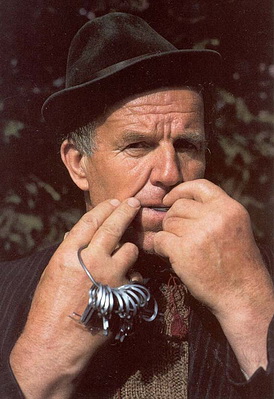 This ethnomusicological field study began with a photograph. In 1999 Philippe Dallais noticed Andrzej Polec's image of a Hutsul man playing a jaw harp in the Ukrainian Carpathians. Polec confirmed that local drymba making had survived and encouraged the researchers to meet the makers. A small team from the Neuchâtel University Institute of Ethnology set out to investigate the instrument's place in contemporary Hutsul life.
People, region and identity
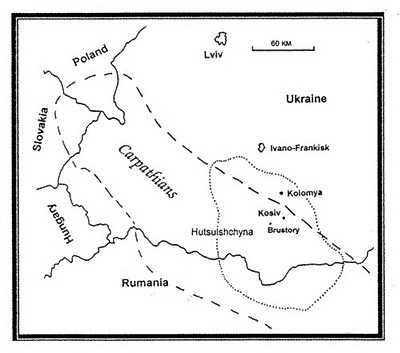
The Hutsul homeland lies in the Carpathians, chiefly in western Ukraine and partly in Romania. Names and categories used for the population vary among languages and historical periods: Hutsuls have often been placed within the wider Rusyn or Carpatho-Rusyn world alongside Boykos and Lemkos. Much early scholarship was produced while Galicia belonged to Poland between the world wars. Under the Soviet Union the remote region was difficult for foreign researchers to visit. After Ukrainian independence in 1991, Hutsul identity became more visible within a complicated ethnonational landscape.
What the researchers looked for
The team wanted to understand why the drymba remained present among the Hutsuls while disappearing from many neighbouring traditions. They documented manufacturing techniques, construction types, playing practices and the social meanings attached to the instrument. They also asked whether the drymba had become an ethnic emblem comparable to the khomus in Yakutia or the mukkuri among the Ainu, or whether it was an inherited craft approaching extinction.
Makers and instruments
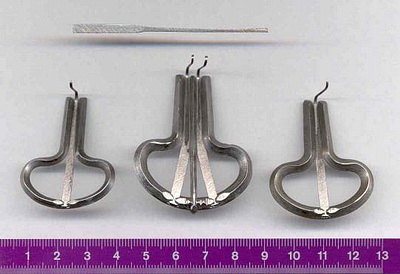
The surviving instruments fell into several related forms. Two had different shapes at the base of the frame; another used two reeds. Examples were obtained directly from makers, private owners and the market in Kosiv. Vasyl Shatruk's work was especially important. His family tradition included both single and double drymbas, showing that the double form was not a recent invention. The characteristics of these instruments also suggest historical contact with Central European jaw harp making.
Making was not taught as a formal part of metalworking education at the Kosiv College of Decorative and Applied Arts. Instead, knowledge survived in households and individual workshops. Some makers combined several roles: farmer, blacksmith, musician and maker. Mykhailo Tavychuk, for example, performed with his family in Ukraine and abroad, made drymbas and also built traditional trembitas from wood struck by lightning.
Playing and social memory
Finding active players proved harder than finding memories of the instrument. Markets did not necessarily offer drymbas even in places where older people had once played them. In Verkhovyna, an elderly woman selling tobacco leaves recognised the instrument, played it skilfully after many years, wiped it on her sleeve in the habitual gesture of an experienced player, and returned it to the researchers.
The instrument belonged especially to intimate and domestic music. Its small volume favoured personal playing, courtship, family gatherings and situations where sound was meant for people nearby rather than a large audience. Hutsul musicians could integrate it with local melodic and rhythmic practice, while makers adapted the physical construction to the sound they valued.
Survival or disappearance?
The study found an exceptional survival rather than an uninterrupted mass tradition. Knowledge was still present, but often in fragments: a handful of makers, older players, family memories and occasional radio or staged performances. Tourism and renewed interest in Hutsul culture could support the drymba, yet could also turn it into a decorative emblem detached from everyday musical practice.
The future therefore depended on more than preserving objects. A living tradition requires makers who can transmit accurate craft, players who use the instrument musically, and social settings in which the sound still has meaning. The fieldwork recorded a moment when all three still existed, though none could be taken for granted.
Read the original study
This page is an English overview. The full paper was originally published in English as The Drymba among the Hutsul in the Ukrainian Carpathians: A Recent Ethnomusicological Survey. The Russian version on Oberton Pro contains the complete Russian translation with the full set of photographs and references.